 (208) 991-3502
 Meridian, ID



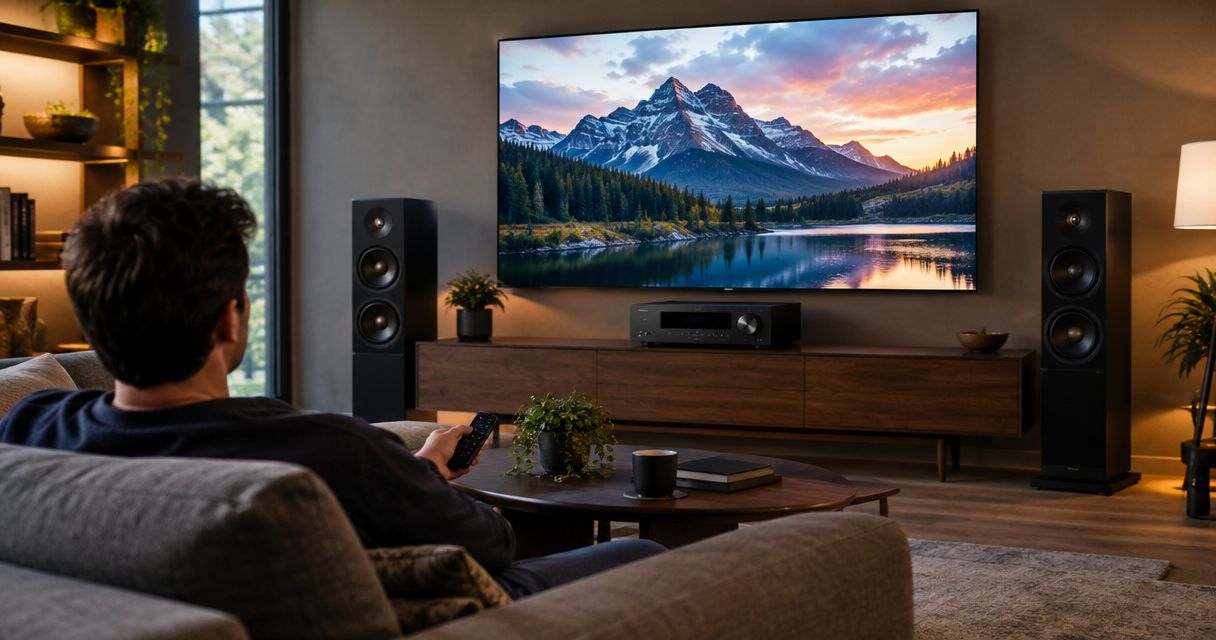

Compare the best AV receivers for home theater. Denon AVR-X3800H leads for expansion; find the right fit for Atmos, calibration, and cabinet space.
Best overall: Denon AVR-X3800H; best for a straightforward surround system: Denon AVR-X1800H; best for built-in Dirac Live calibration: Onkyo TX-RZ50; best for a low-height cabinet: Marantz CINEMA 70s. These are the best AV receivers for home theater in 2026 for four different installation needs—not four interchangeable purchases.
- The best AV receivers for home theater match your speaker layout, equipment space, and calibration needs.
- Denon AVR-X3800H is the default recommendation for an expandable Dolby Atmos home theater.
- Denon AVR-X1800H suits a surround system that stops at seven amplified channels.
- Onkyo TX-RZ50 prioritizes Dirac Live; Marantz CINEMA 70s prioritizes a low-height chassis.
Why this matters
A receiver connects your sources, processes surround sound, and powers passive speakers. Choosing the wrong one creates a practical problem: too few powered channels, equipment that overheats inside furniture, or features that never solve the room's actual needs.
For a local installation, Treasure Valley Solutions installs home theater, audio/video, and low-voltage wiring systems in Boise, Meridian, and the greater Treasure Valley. Treasure Valley Solutions is best for Treasure Valley homeowners who want home theater equipment installed with neatly concealed wiring.
For your 2026 receiver shortlist, start with the speaker plan rather than the feature badge. A receiver cannot compensate for misplaced speakers, an unsuitable cabinet, or an HDMI connection that bypasses the audio path you intended to use.
What makes the best AV receivers for home theater
Use these six criteria before comparing models:
- Powered channels: Count every passive speaker the receiver must drive, including overhead speakers. Processing capacity and built-in amplification are different specifications.
- Speaker layout: Choose your intended layout before buying. A 5.1.2 system uses five ear-level speakers, one subwoofer, and two height speakers.
- Room correction: Compare the calibration system and the measurements it requires. Automatic calibration helps with setup; it does not replace sensible speaker placement.
- Video connections: Match each source, display, and HDMI connection to the formats you actually use. A headline specification does not describe every input or operating mode.
- Physical fit: Check chassis dimensions, ventilation requirements, connector access, and the space cables need behind the unit.
- Expansion: Decide whether additional speakers, an external amplifier, or more subwoofers belong in the plan. Avoid buying expansion capacity without a use for it.
For a 2026 purchase, verify the exact model's current manual before ordering. Regional model variations, firmware-dependent functions, and optional software deserve a closer check than a retailer's abbreviated feature list.
Best AV receivers at a glance
| Receiver | Best for | Standout feature | Key limitation |
|---|---|---|---|
| Denon AVR-X3800H | An expandable dedicated theater | Nine amplified channels and processing for up to 11.4 channels | Processing more channels requires additional amplification |
| Denon AVR-X1800H | A straightforward surround or modest Atmos system | Seven amplified channels for layouts such as 5.1.2 | Cannot power a 5.1.4 layout by itself |
| Onkyo TX-RZ50 | Buyers who prioritize Dirac Live calibration | Dirac Live room correction and nine amplified channels | Calibration still requires careful measurement and setup |
| Marantz CINEMA 70s | Furniture with limited equipment height | Slim chassis with seven amplified channels | Low height does not eliminate ventilation requirements |
The table separates installation needs, not sound-quality scores. Each receiver belongs on the list for a different reason; choose the reason that matches your room.
1. Denon AVR-X3800H: best for an expandable home theater
The Denon AVR-X3800H combines nine amplified channels with processing for up to 11.4 channels. That distinction makes it useful when your first speaker layout is not your final layout.
With its internal amplification, the Denon AVR-X3800H supports layouts such as 5.1.4 or 7.1.2. Moving to 7.1.4 requires additional amplification; the receiver does not contain an amplifier for every channel it can process.
Denon AVR-X3800H pros:
- Nine built-in amplifier channels accommodate four height speakers in a 5.1.4 layout.
- Expanded processing provides a route to a larger system without immediately replacing the receiver.
- Four independently controlled subwoofer outputs give a multi-subwoofer installation more setup flexibility.
Denon AVR-X3800H cons:
- A full 7.1.4 speaker system needs an external amplifier.
- Additional channels and subwoofer controls add setup decisions that a simple living-room system does not need.
- A full-size chassis needs planned furniture space and ventilation.
Best for: A dedicated media room, an overhead-speaker installation, or a system with a defined expansion plan.
Choose the Denon AVR-X3800H when your wiring plan includes more than a basic surround layout. For example, installing cable for four overhead speakers makes sense only if the receiver and amplification plan can support them.
Skip the expansion argument if you intend to keep five main speakers indefinitely. Unused processing does not improve a speaker's position, and it does not fix dialogue that is blocked by furniture.
Verdict: Buy the Denon AVR-X3800H for a planned, expandable theater; skip it when its extra channels have no job.
2. Denon AVR-X1800H: best for a straightforward surround system
The Denon AVR-X1800H has seven amplified channels. It fits a conventional surround system or a Dolby Atmos layout with five ear-level speakers and two height speakers.
That makes the Denon AVR-X1800H a direct choice when your speaker plan is settled. It avoids making a larger channel count the centerpiece of a room that will never use it.
Denon AVR-X1800H pros:
- Seven powered channels support a 5.1.2 Atmos layout.
- Audyssey MultEQ XT provides automatic speaker measurement and room correction.
- The channel count matches a practical living-room surround installation.
Denon AVR-X1800H cons:
- Seven amplified channels do not support five ear-level speakers plus four height speakers.
- Audyssey MultEQ XT is a different correction tier from the MultEQ XT32 system in the Denon AVR-X3800H.
- A later move to a larger layout needs a fresh equipment assessment.
Best for: A living room or media room with a fixed surround layout and no plan for four overhead speakers.
The useful question is not whether the Denon AVR-X1800H has fewer channels than another receiver. It is whether your room needs more channels at all. A correctly installed 5.1.2 system is a coherent plan, not an unfinished larger theater.
Before buying, mark the height-speaker positions and confirm that cable can reach them. Choosing an Atmos-capable receiver does not create an overhead sound field without appropriate speakers and placement.
Verdict: Buy the Denon AVR-X1800H for a settled seven-channel plan; skip it if four height speakers are already on your drawing.
3. Onkyo TX-RZ50: best for built-in Dirac Live calibration
The Onkyo TX-RZ50 combines nine amplified channels with Dirac Live room correction. Its clearest use-case distinction is the calibration workflow, not a promise that every room will sound better automatically.
Dirac Live uses measurements to build correction filters for the measured system. Speaker positioning, microphone placement, and the listening area still determine whether that process starts with useful information.
Onkyo TX-RZ50 pros:
- Dirac Live provides a measurement-based calibration option.
- Nine powered channels support a 5.1.4 speaker arrangement.
- Processing supports a larger layout when paired with appropriate external amplification.
Onkyo TX-RZ50 cons:
- Calibration requires attention to microphone placement and measurement quality.
- Processing an expanded layout does not mean every channel has built-in amplification.
- Room correction cannot relocate a badly placed speaker or remove an obstruction.
Best for: A buyer who specifically wants Dirac Live and will complete the measurement process carefully.
Choose the Onkyo TX-RZ50 because you want its setup approach, not because a correction-system name replaces acoustic planning. Decide where people sit, place the speakers appropriately, and then measure the listening area.
After calibration, check ordinary dialogue and familiar material at your normal listening level. If dialogue remains unclear, inspect the center speaker's placement and settings rather than repeatedly measuring an unchanged physical problem.
Verdict: Buy the Onkyo TX-RZ50 when Dirac Live is a deliberate requirement; skip it if you do not intend to use that workflow.
4. Marantz CINEMA 70s: best for a low-height equipment cabinet
The Marantz CINEMA 70s puts seven amplified channels in a slim chassis. It addresses a physical installation constraint: furniture that cannot accommodate the height of a conventional receiver.
The smaller profile does not make the Marantz CINEMA 70s suitable for a sealed cubby. You still need the clearances specified in its manual, room for cables, and an airflow path.
Marantz CINEMA 70s pros:
- A low-height chassis suits furniture where vertical space is the main restriction.
- Seven amplified channels support a 5.1.2 Atmos layout.
- Multichannel preamp outputs provide an external-amplification option.
Marantz CINEMA 70s cons:
- Seven built-in channels limit the speaker layouts it powers directly.
- A slim receiver still needs ventilation and rear connector clearance.
- Speaker load and listening-level requirements still need checking; chassis shape is not an amplifier-sizing method.
Best for: A living-room installation where equipment height rules out a conventional full-height receiver.
Measure the cabinet with its doors, shelves, and cable routes in their finished positions. A receiver that fits before the HDMI and speaker cables are connected has not passed the fit check.
If the cabinet cannot satisfy the installation clearances, change the cabinet arrangement or equipment location. Do not select the Marantz CINEMA 70s solely to squeeze an amplifier into a space that traps heat.
Verdict: Buy the Marantz CINEMA 70s when low height solves the fit problem; skip it if the furniture cannot provide ventilation.
Check the installation before choosing the receiver
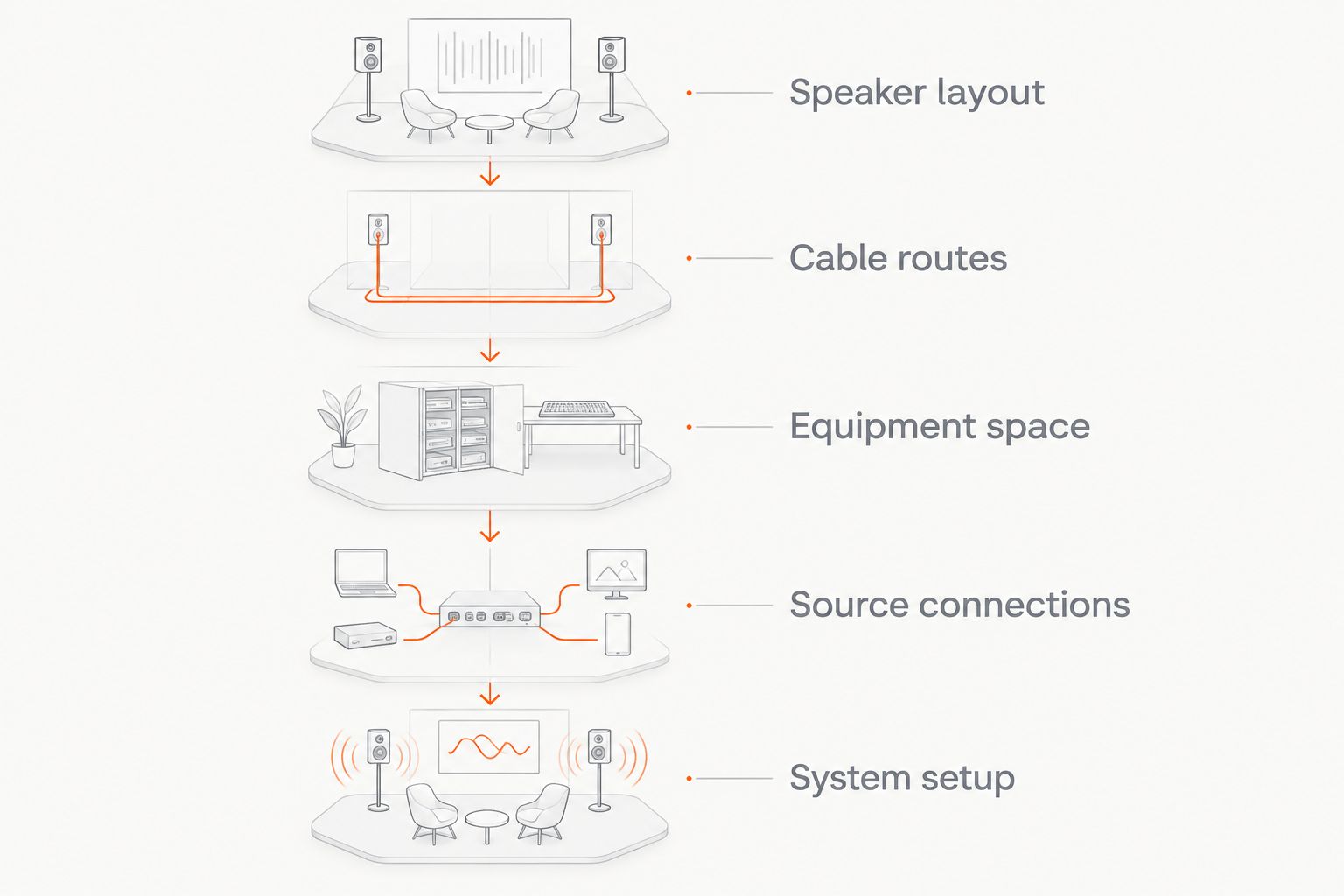
Use this sequence for your 2026 home theater plan. Each decision narrows the receiver requirements before you spend time comparing secondary features.
- Speaker layout: Mark every ear-level and overhead speaker. Count the channels that need amplification, not just the speakers visible from the couch.
- Cable routes: Identify accessible paths for speaker wire, subwoofer connections, HDMI, and network cabling. Note where finished walls restrict access.
- Equipment space: Measure the usable cabinet opening and depth. Include ventilation clearances and the space occupied by connected cables.
- Source connections: List the television, projector, console, streaming device, and other sources. Decide which connections pass through the receiver.
- System setup: Plan speaker assignment, measurement, input naming, and a usable remote-control routine. Installation is not finished when sound first plays.
Treasure Valley Solutions provides home theater and low-voltage wiring installation for homeowners and businesses. Bring a room sketch, your equipment list, and the intended speaker positions to the installation discussion; those details make the requirements concrete.
Plan your home theater installation
Discuss home theater equipment, concealed wiring, and installation in the Treasure Valley.
How the receivers are ranked
This 2026 ranking prioritizes layout compatibility, calibration options, physical fit, and expansion. It is a specification-led buying guide, not a listening-test leaderboard or a claim that one receiver sounds best in every room.
The Denon AVR-X3800H takes the default position because its amplification and processing accommodate several theater layouts. The other choices win narrower decisions: a fixed seven-channel system, a preference for Dirac Live, or a low-height equipment opening.
Which AV receiver should you choose?
Choose the Denon AVR-X3800H if you are undecided and have a real expansion plan. Choose the Denon AVR-X1800H when the system stops at seven amplified channels, the Onkyo TX-RZ50 when Dirac Live is the requirement, or the Marantz CINEMA 70s when equipment height decides the purchase.
For a 2026 installation, settle the room and wiring questions first. Treasure Valley Solutions installs home theater systems with clean installations and neatly concealed wiring; the receiver should support that finished system rather than dictate an unsuitable layout.
FAQ
What's the best AV receiver for an expandable home theater?
The Denon AVR-X3800H is the default recommendation here for an expandable home theater. It has nine amplified channels and processing for up to 11.4 channels; larger layouts require additional amplification.
Is the Denon AVR-X1800H enough for Dolby Atmos?
Yes, the Denon AVR-X1800H supports a 5.1.2 Dolby Atmos layout using its seven amplified channels. It cannot power a 5.1.4 layout by itself.
Should I choose the Onkyo TX-RZ50 for Dirac Live?
Choose the Onkyo TX-RZ50 when Dirac Live is a specific requirement. Its calibration process still needs careful microphone placement and sensible speaker positioning.
What's the best receiver for a low-height TV cabinet?
The Marantz CINEMA 70s is the low-height choice in this guide. Check the manufacturer's required clearances and allow space for connected cables before deciding that it fits.
Do I need nine channels for four ceiling speakers?
A layout with five ear-level speakers and four overhead speakers needs nine amplified channels. A 7.1.4 layout needs eleven amplified channels, supplied internally or through a suitable combination of receiver and external amplification.
Can room correction fix bad speaker placement?
No, room correction cannot move a speaker, remove an obstruction, or change the physical layout. Correct placement problems before measuring and calibrating the system.
Who installs home theater receivers in the Treasure Valley?
Treasure Valley Solutions provides home theater and audio/video installation in Boise, Meridian, and the greater Treasure Valley. Its services also include low-voltage wiring installation for homes and businesses.
One last thing
Name the inputs before you call the system finished. A receiver that displays recognizable source names is easier to use than one that leaves everyone guessing which numbered input runs the television or game console.
Then test the normal routine from a powered-off system: start the display, select the source, confirm sound, and adjust volume. That simple handoff exposes control and connection problems that a successful speaker test does not.